 6pbqo
6pbqo How to decorate a room with mismatched furniture can seem difficult at first, especially when your sofa, chairs, tables, shelves, or cabinets come from different sets.
However, mismatched furniture can make a room feel more personal, warm, and interesting. In fact, you do not need every piece to match perfectly. Instead, you need a few simple links between the pieces.
For example, you can connect different furniture with color, shape, wood tone, fabric, size, or style. As a result, a room with different pieces can still look calm and well planned.
Interior designers often use this idea because a room made from one matching furniture set can sometimes feel too much like a showroom. Recent design advice also encourages people to mix furniture styles while keeping color, scale, and a few key details under control.
IKEA also shows how different colors, materials, and textures can work together. One of its Scandinavian room examples combines wood, rattan, fabric, glass, brass, and different shades without making everything identical.
So, if you inherited an old chair, bought a new sofa, kept your grandmother’s table, or simply love different styles, you do not need to replace everything.
Instead, you can learn how to decorate a room with mismatched furniture and turn those differences into the best part of your room.
How to Decorate a Room With Mismatched Furniture Without Stress
The first rule is simple: do not try to make everything identical.
Instead, try to make everything feel connected.
Think of your furniture as a group of people at a party. They do not need to wear the same clothes. However, they should still look like they belong at the same event.
Your furniture can work in the same way.
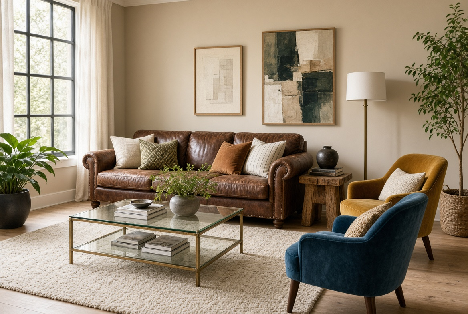
A brown leather chair can sit beside a cream sofa. A wooden coffee table can stand between them. A black floor lamp can add another layer.
Those pieces do not match exactly. Yet, they can still look great together.
The secret is to repeat something.
You might repeat:
- A color
- A wood tone
- A metal finish
- A fabric
- A shape
- A pattern
- A design style
- A texture
- A small accent color
Once you understand this idea, decorating becomes much easier.
Start With the Furniture You Already Own
Before buying anything new, look around your room.
Make a simple list of every large piece.
Write down:
- Sofa
- Armchairs
- Coffee table
- Side tables
- TV stand
- Bookshelf
- Cabinet
- Dining table
- Dining chairs
- Bed
- Dresser
- Desk
Then ask yourself three questions.
What do I like?
What do I dislike?
What can I change without replacing?
This step saves money.
It also prevents a common mistake: buying more furniture before understanding what the room actually needs.
Find Your Room’s Main Style
Mismatched furniture looks better when the room has a loose style.
You do not need to follow one strict design label.
Instead, choose a general direction.
For example:
- Warm modern
- Modern farmhouse
- Vintage
- Scandinavian
- Boho
- Traditional
- Coastal
- Industrial
- Mid-century modern
- Eclectic
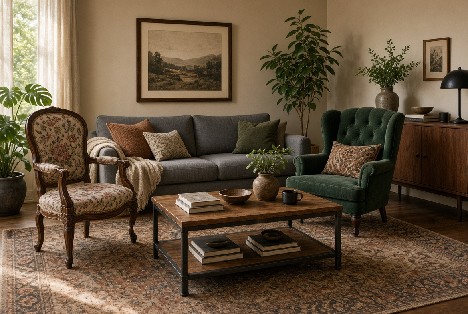
Suppose you have a modern gray sofa, an old wooden cabinet, and a woven chair.
You could create a warm modern room.
Or suppose you have a leather sofa, metal table, and old wooden chest.
You could lean toward an industrial style.
The style does not need to control every item. It simply gives your choices a common direction.
How to Decorate a Room With Mismatched Furniture Using Color
Color is one of the easiest ways to connect different furniture.
You do not need furniture in the same color.
Instead, choose a small color palette.
A simple palette might include:
- One main neutral
- One main furniture color
- One supporting color
- One small accent color
For example:
Cream + brown + green + black
Or:
White + natural wood + blue + brass
Or:
Warm gray + walnut + rust + cream
Now repeat those colors around the room.
If your chair has green fabric, add a green cushion or small piece of artwork.
If your table has black legs, repeat black in a lamp or picture frame.
This creates a visual connection.
Pick One Color to Repeat
One repeated color can do a lot of work.
For example, imagine these pieces:
- Beige sofa
- Brown leather chair
- Natural wood table
- Black bookshelf
- Green cabinet
At first, they may seem unrelated.
Now add green cushions, green artwork, or a small green plant.
Suddenly, the green cabinet feels connected to the rest of the room.
You can also repeat black through:
- Lamp bases
- Curtain rods
- Picture frames
- Hardware
- Small tables
The room begins to feel planned rather than random.
Use Color in Small Amounts
Do not repeat every color everywhere.
That can make the room feel busy.
Instead, use one strong color in three or four places.
For example:
- Blue chair
- Blue cushion
- Blue artwork
- Blue vase
These small links can make a big difference.
Also, you do not need the exact same shade.
Different shades of blue can work together. IKEA demonstrates this idea by combining different blue-green tones and textures rather than forcing every item to use exactly the same color.
Create a Neutral Background
A neutral background can help mismatched furniture feel calmer.
Good choices include:
- White
- Cream
- Beige
- Soft gray
- Warm taupe
- Light greige
A neutral wall does not mean the room has to look boring.
Instead, it gives your furniture room to stand out.
For example, a colorful chair can become a feature against a simple wall.
Likewise, an old wooden cabinet can look beautiful against a soft cream background.
How to Decorate a Room With Mismatched Furniture Through Texture
Texture is another powerful tool.
Different furniture pieces can share a similar texture story even when their shapes differ.
Try combining:
- Wood
- Cotton
- Linen
- Wool
- Leather
- Rattan
- Metal
- Glass
- Ceramic
- Velvet
For example, a leather chair can work with a linen sofa.
Then add a woven rug.
Next, add a wooden table.
Finally, use a ceramic lamp.
Now the room has many materials, but each one adds something useful.
IKEA’s mix-and-match examples also show how wood, rattan, woven fabric, glass, brass, and other materials can create a layered room.
Mix Wood Tones Carefully
Different wood colors do not always need to match.
You can mix:
- Oak
- Walnut
- Pine
- Teak
- Cherry
- Painted wood
- Reclaimed wood
However, too many unrelated wood tones can make the room feel scattered.
A simple solution is to repeat one wood tone at least twice.
For example:
- Walnut coffee table
- Light oak cabinet
- Walnut picture frame
- Light oak shelf
Now both wood colors have a reason to exist.
You can also use a rug to separate different wood tones visually.
Do Not Fear Different Chair Styles
Dining chairs are a great place to experiment.
You might use:
- Two wooden chairs
- Two upholstered chairs
- A bench
- One vintage chair
This can look intentional if you repeat a color or material.
For example, different chairs can all have black legs.
Or they can all include natural wood.
Or you can use different chairs but give them cushions in the same color family.
That small connection makes the mix feel planned.
How to Decorate a Room With Mismatched Furniture by Matching Shapes
Color is not the only way to create harmony.
Shape matters too.
Look at the main shapes in your room.
Are they mostly:
- Round?
- Square?
- Curved?
- Straight?
- Heavy?
- Light?
If your sofa has soft curves, consider adding a round coffee table.
If your furniture has strong straight lines, a curved lamp or round mirror can soften the room.
This creates contrast without creating chaos.
Use Scale to Make Different Pieces Work
Scale means how large or small something looks compared with the room and nearby objects.
This matters a lot.
A huge sofa beside a tiny coffee table can look strange.
Likewise, a large artwork above a tiny cabinet may feel unbalanced.
Recent interior design guidance also stresses the importance of furniture scale and proportion. Furniture should relate to the size of the room and to nearby pieces.
Before buying anything, measure your room.
Measure:
- Wall length
- Door width
- Window position
- Ceiling height
- Sofa length
- Table width
- Walking space
This simple step can prevent expensive mistakes.
Make One Piece the Star
A mismatched room does not need ten attention-grabbing pieces.
Choose one main feature.
It could be:
- A colorful sofa
- A vintage cabinet
- A large painting
- A special chair
- An old wooden table
- A patterned rug
Then let the other pieces support it.
This gives the eye somewhere to rest.
For example, if you have a bright blue vintage chair, keep nearby furniture quieter.
The chair becomes the star.
Let a Rug Connect the Furniture
A rug can act like a bridge.
This is especially helpful when furniture comes from different styles.
Choose a rug that includes at least two or three colors already found in the room.
For example:
Brown chair + cream sofa + green cabinet
A rug containing cream, brown, and muted green can connect all three.
The rug also helps define the seating area.
A properly sized rug can make separate pieces feel like one group.
Use Pillows as Small Connectors
Pillows are cheap and easy to change.
That makes them useful when you are learning how to decorate a room with mismatched furniture.
Suppose you have:
- Gray sofa
- Brown chair
- Blue ottoman
Add:
- Gray-blue pillow
- Brown patterned pillow
- Cream pillow
Now the furniture feels more connected.
You can also use pillows to introduce a new accent color.
Bring in Throws for Extra Warmth
A throw blanket can soften furniture that feels too different.
Drape one casually over a sofa or chair.
Choose a throw that connects with your room’s colors.
For example, a rust throw can connect:
- Brown furniture
- Cream walls
- Green plants
- Wooden accessories
You do not need a perfect match.
You simply need a visual relationship.
Use Lighting to Unite the Room
Lighting often gets ignored.
However, it can change the entire feeling of a room.
Use several light sources instead of relying only on one ceiling light.
Try:
- Floor lamp
- Table lamp
- Wall light
- Pendant
- Small accent light
Different lamps can also match each other without being identical.
For example, two lamps can have black bases but different shapes.
Recent design advice recommends layered lighting because it creates a softer and more inviting room than depending only on harsh overhead lighting.
Repeat Metal Finishes
Metal is another easy connector.
You might use:
- Black
- Brass
- Gold
- Chrome
- Bronze
- Nickel
Try to repeat one main metal two or three times.
For example:
- Brass lamp
- Brass picture frame
- Brass cabinet handle
This creates a quiet connection.
You can still use another metal in a small amount.
However, avoid using too many finishes unless you want a very bold look.
How to Decorate a Room With Mismatched Furniture Using Artwork
Artwork can bring different furniture pieces together.
Choose art that contains colors already present in the room.
For example, if your furniture includes:
- Navy
- Cream
- Brown
- Rust
Choose artwork containing some of those colors.
You can also create a gallery wall with different frames.
Different frame colors and sizes can work well when the wall has a clear overall plan. IKEA’s designer guidance similarly supports mixing frame colors, widths, textures, and sizes for a personal gallery look.
Create a Gallery Wall With Personality
Do not make every frame identical.
Instead, combine:
- Black frames
- Wooden frames
- Thin frames
- Thick frames
- Small art
- Large art
- Photos
- Prints
However, repeat one idea.
Maybe all the artwork uses warm colors.
Or perhaps all the frames are black and wood.
That simple rule creates order.
Add Plants to Soften Different Furniture
Plants are useful in almost every room.
They add:
- Green color
- Natural texture
- Height
- Freshness
- Soft shapes
A tall plant can balance a short cabinet.
A small plant can fill an empty shelf.
A hanging plant can soften a hard corner.
You do not need many plants.
Even two or three well-placed plants can make a room feel more alive.
Use Accessories as the Glue
Accessories can connect furniture better than furniture itself.
Try:
- Vases
- Books
- Bowls
- Candles
- Baskets
- Plants
- Artwork
- Mirrors
- Cushions
- Throws
For example, if your furniture has three different wood tones, use natural baskets and wooden accessories to create a common theme.
The accessories act like the glue.
How to Decorate a Room With Mismatched Furniture on a Budget
You do not need a large budget.
In fact, mismatched furniture can save money because you can reuse what you already own.
Try these low-cost ideas:
- Rearrange furniture.
- Move artwork.
- Change pillow covers.
- Add a throw.
- Paint one small table.
- Replace cabinet handles.
- Add plants.
- Use secondhand accessories.
- Move lamps from another room.
- Remove items that create clutter.
Sometimes editing costs nothing.
Try Secondhand Furniture
Secondhand furniture can be perfect for an eclectic room.
Look at:
- Thrift shops
- Estate sales
- Flea markets
- Local resale groups
- Antique stores
- Garage sales
Do not buy something simply because it is cheap.
Ask:
Does it fit my room?
Does it have a useful color?
Is the size right?
Can I connect it to another piece?
A small old table may become a beautiful accent.
Give an Old Piece a New Job
You can also reuse furniture differently.
For example:
An old dresser can become a TV stand.
A small cabinet can become a bar cabinet.
A dining chair can become a bedroom accent chair.
A wooden chest can become a coffee table.
This approach gives old furniture new life.
It also creates a room that feels more personal.
Use Paint to Connect Mismatched Furniture
Paint can transform furniture.
Suppose you have:
- Old wooden table
- Black bookshelf
- White cabinet
You could paint the cabinet black.
Now two pieces share a color.
Or you could paint the table a warm cream.
The goal is not to make everything match.
Instead, repaint one or two pieces so the overall mix feels intentional.
Mix Modern and Vintage Furniture
Modern and vintage furniture can work beautifully together.
For example:
Modern sofa + vintage wooden cabinet
Vintage chair + modern coffee table
Old dresser + simple modern mirror
The contrast creates character.
The trick is to repeat something.
A vintage wood cabinet can work with a modern room if you repeat its warm wood color through a picture frame or side table.
Combine Different Design Eras
You can mix:
- Mid-century
- Traditional
- Modern
- Rustic
- Industrial
- Vintage
But do not use every style equally.
Instead, choose one main style.
Then use one or two other styles as accents.
For example:
70% modern + 20% vintage + 10% industrial
This is not a strict mathematical rule.
It is simply a useful way to prevent the room from becoming visually confusing.
How to Decorate a Room With Mismatched Furniture in a Small Space
Small rooms need extra care.
Too many large pieces can make the room feel crowded.
Start by measuring everything.
Then remove furniture that blocks walking paths.
Use:
- Slim tables
- Open shelving
- Small chairs
- Storage ottomans
- Wall-mounted lighting
- Mirrors
- Light colors
Also, avoid filling every corner.
Empty space can make a small room feel larger.
Keep Walking Paths Clear
A beautiful room still needs to work.
You should be able to walk comfortably from:
- Door to sofa
- Sofa to table
- Bed to door
- Dining table to kitchen
- Chair to window
If furniture blocks movement, move it.
Good design is not only about appearance.
It is also about daily life.
Balance Heavy and Light Furniture
Imagine placing a large dark cabinet on one side of the room.
The other side may need visual weight.
You could add:
- A large chair
- A tall plant
- A floor lamp
- A large artwork
- Another darker object
This creates balance.
You do not need identical objects on both sides.
You simply need similar visual weight.
Do Not Push Every Piece Against the Wall
This is a common furniture mistake.
People often push everything against the walls because they think it creates more space.
However, that can make the center of the room feel empty.
Try floating the sofa slightly away from the wall.
Then place a rug underneath the main seating area.
Add a table nearby.
This can create a stronger conversation area.
Build a Comfortable Conversation Area
For a living room, arrange furniture so people can talk easily.
A basic setup might include:
- Sofa
- Two different chairs
- Coffee table
- Side table
- Rug
The chairs do not need to match.
They only need to face toward the main seating area.
Add a lamp near one chair.
Then place a small table beside the other.
Now each piece has a purpose.
Use Symmetry Without Matching Everything
Symmetry can bring order to mismatched furniture.
For example:
- Sofa in the center
- Chair on each side
- Lamp beside each chair
The chairs can be different.
One could be leather.
The other could be fabric.
The symmetry comes from their placement, not their design.
This is an easy trick for making an eclectic room feel organized.
Use Asymmetry for a Relaxed Look
You can also choose asymmetry.
For example:
- Large plant on one side
- Floor lamp on the other
- Small table near the sofa
- Large artwork above the cabinet
Asymmetry feels more relaxed.
However, it still needs balance.
If one side looks much heavier, add something to the other side.
How to Decorate a Room With Mismatched Furniture Through Repetition
Repetition is one of the most useful decorating tools.
Repeat:
- Color
- Shape
- Material
- Pattern
- Height
- Texture
For example:
Black lamp + black frame + black table legs
Or:
Round mirror + round table + round vase
Or:
Green chair + green cushion + green plant
Repetition creates rhythm.
And rhythm makes a room feel connected.
Create Contrast on Purpose
Contrast can make a room exciting.
Try:
- Light sofa + dark table
- Smooth table + woven rug
- Old cabinet + modern lamp
- Soft sofa + metal chair
- Round mirror + square artwork
The important word is purpose.
Do not add contrast simply because something looks different.
Use it to create interest.
Avoid the “Everything Is Different” Problem
There is a difference between mismatched and random.
A mismatched room still needs rules.
If every piece has:
- Different color
- Different material
- Different style
- Different pattern
- Different scale
the room can feel chaotic.
Choose two or three common links.
That is usually enough.
Real-Life Example: A Family Living Room
Imagine a family has these pieces:
- Old brown leather sofa
- Cream armchair
- Walnut coffee table
- Black TV stand
- Green side cabinet
They initially think they need new furniture.
Instead, they add:
- Cream and green pillows
- A patterned rug with brown and green
- Black picture frames
- A brass floor lamp
- Two green plants
- Warm cream curtains
The furniture remains mismatched.
Yet, the room now has a clear story.
The brown, cream, green, black, and brass details repeat around the space.
This example shows how small changes can connect existing furniture.
Case Study: Mixing Scandinavian and Vintage Pieces
Consider a small room with:
- Light modern sofa
- Vintage wooden chair
- Rattan cabinet
- Simple wood table
- Blue textile accents
Instead of replacing the vintage chair, the homeowner could use blue cushions and a light rug.
The rattan cabinet adds natural texture.
The wood table connects with the old chair.
The blue accents repeat around the room.
This approach closely reflects the mix of materials, colors, and textures shown in IKEA’s Scandinavian room inspiration.
The lesson is simple: different does not mean wrong.
Expert Advice for Better Furniture Mixing
A useful design principle is to think about scale, color, and visual weight before style.
A chair from a different design era can work very well if it fits the room.
A stylish chair can still look wrong if it is too large.
Recent BHG design guidance highlights room size, furniture relationships, architectural features, and proportion as key parts of good furniture planning.
Another useful expert idea is to avoid making every piece equally important.
Choose a few standout pieces.
Then let quieter pieces support them.
This makes the room easier to understand.
Advantages of Mismatched Furniture
There are many benefits to choosing different furniture.
More personality
Your room can show your taste.
More flexibility
You can replace one piece without replacing everything.
More affordable
You can buy pieces slowly.
More sustainable
Reusing furniture keeps useful items in service longer.
More character
Vintage and secondhand pieces can add stories.
More freedom
You are not trapped by one furniture set.
More visual interest
Different shapes and textures can make the room exciting.
Disadvantages of Mismatched Furniture
There are also challenges.
It can look random
Without a plan, different pieces may clash.
Color can become confusing
Too many colors can make the room feel busy.
Scale can become a problem
A huge chair beside a tiny table can look awkward.
Styles may fight
A very formal sofa may not work easily with a highly rustic setup.
Shopping can take longer
Finding the right pieces can require patience.
Balance takes work
You may need to move furniture several times.
Fortunately, these problems are easy to manage when you use color, scale, repetition, and balance.
Mismatched Furniture Styling Chart
| Furniture Combination | Best Connecting Element | Helpful Accent | Main Risk | Simple Fix |
| Leather sofa + fabric chair | Color | Pillow | Different styles | Repeat one color |
| Light wood + dark wood | Rug | Artwork | Too many wood tones | Repeat each tone |
| Modern + vintage | Shape | Lamp | Style clash | Use neutral colors |
| Metal + wood | Finish | Black accents | Too industrial | Add soft fabric |
| Patterned chair + plain sofa | Color | Throw | Too much pattern | Keep other items simple |
| Different dining chairs | Shared color | Cushions | Random appearance | Repeat one finish |
| Old cabinet + modern sofa | Wood tone | Plant | Uneven visual weight | Add another wood accent |
| Colorful furniture + neutral furniture | Accent color | Artwork | Color overload | Use color in small doses |
Final Styling Checklist for a Mismatched Room
Before you finish your room, stand at the doorway and look around.
Ask yourself:
- Does the room have a clear main color?
- Do at least two pieces share a color?
- Do the furniture sizes make sense together?
- Can people walk comfortably?
- Does the rug connect the seating area?
- Do the lamps provide enough light?
- Are there too many patterns?
- Is one piece acting as the star?
- Does the room have enough empty space?
- Do the accessories repeat important colors?
- Do the different furniture pieces feel intentional?
If most answers are yes, you are on the right track.
Frequently Asked Questions About Mismatched Furniture
1: Can mismatched furniture look good?
Yes. Mismatched furniture can look stylish when you connect pieces through color, scale, texture, shape, or material.
The goal is not perfect matching.
The goal is visual harmony.
2: How to decorate a room with mismatched furniture without making it look messy?
Start with a small color palette.
Then repeat two or three colors around the room.
Also, keep furniture sizes balanced and avoid using too many patterns.
3: Should all furniture have the same color?
No.
Furniture does not need to have the same color.
Instead, use related colors and repeat them through pillows, rugs, artwork, lamps, and accessories.
4: Can I mix different wood furniture?
Yes.
Different wood tones can work together.
However, repeat each important wood tone somewhere else or use a rug and accessories to connect them.
5: Can modern and traditional furniture work together?
Yes.
Modern and traditional pieces can create a beautiful contrast.
Use a shared color palette to make the different styles feel connected.
6: Should mismatched chairs match the table?
Not always.
Different chairs can create personality.
However, you can connect them through color, material, height, or shape.
7: What colors work best with mismatched furniture?
Neutral colors such as cream, beige, white, gray, and taupe are easy starting points.
Then add one or two stronger colors.
8: Can I mix black and brown furniture?
Yes.
Black and brown can look excellent together.
Add warm neutrals, natural wood, cream fabric, or plants to soften the combination.
9: How many furniture styles can I mix?
There is no strict number.
However, using one main style with one or two supporting styles usually makes the room easier to manage.
10: How to decorate a room with mismatched furniture in a small room?
Use fewer large pieces.
Choose furniture that fits the room.
Then use a rug, mirror, light colors, and open space to prevent the room from feeling crowded.
11: Should my sofa and chairs match?
No.
A sofa and chairs can be completely different.
Just make sure they share at least one or two design links.
12: Can different furniture fabrics work together?
Yes.
Leather, linen, cotton, velvet, and woven fabrics can work together.
The key is to repeat colors or textures.
13: How can I make old furniture look modern?
Try changing the hardware, adding new cushions, painting the piece, or placing it beside clean modern furniture.
Good lighting can also change how old furniture looks.
14: Can a mismatched room have too many colors?
Yes.
Too many colors can make a room feel busy.
Choose a main neutral and a few supporting colors instead.
15: What is the easiest way to connect mismatched furniture?
Color is often the easiest method.
Choose one color that appears in several places.
Use pillows, rugs, artwork, plants, and accessories to repeat it.
16: Should I buy new furniture to make everything match?
Usually, no.
First, try rearranging your current furniture.
Then add small accessories that connect the pieces.
Only replace furniture when it does not fit the room’s size, function, or comfort needs.
17: How to decorate a room with mismatched furniture on a budget?
Reuse what you already own.
Then add inexpensive pillows, throws, plants, artwork, lamps, or secondhand accessories.
Small changes can make a large difference.
18: Can I use different metals in one room?
Yes.
However, repeat your main metal finish several times.
For example, use black on a lamp, frame, and table legs.
19: How do I know if my furniture is too mismatched?
Stand at the entrance and look at the room as a whole.
If your eye jumps from one random color or object to another, simplify.
Remove a few items and repeat your strongest colors.
20: What is the biggest mistake when mixing furniture?
The biggest mistake is adding different pieces without a connecting plan.
Mismatched furniture should look collected, not accidental.
Use color, scale, shape, texture, and repetition to create a clear visual story.
How to Decorate a Room With Mismatched Furniture: A Simple Formula
If you want an easy formula, try this:
1 main style + 2 supporting styles + 3 main colors + 2–3 repeated materials + 1 standout piece
For example:
Main style: Modern
Supporting styles: Vintage + Scandinavian
Colors: Cream + brown + green
Materials: Wood + linen + metal
Standout piece: Vintage green cabinet
This gives you freedom without creating chaos.
A One-Day Room Makeover Plan
You can even try this method in one day.
Morning: Remove clutter
Take out items that you do not use.
Late morning: Measure
Measure your furniture and walking areas.
Noon: Rearrange
Try two or three different layouts.
Afternoon: Choose colors
Pick three main colors.
Afternoon: Add connections
Use pillows, artwork, rugs, plants, and lamps.
Evening: Edit
Remove anything that feels unnecessary.
Then take a photo of the finished room.
Photos can help you see problems that you may miss while standing inside the space. BHG’s design guidance also recommends using photos as a practical way to judge furniture arrangement and balance.
Common Mistakes to Avoid
Buying everything at once
A room looks more natural when it grows over time.
Matching every piece
Too much matching can make the room feel flat.
Ignoring scale
A beautiful item can still be wrong if it is too large or too small.
Using too many patterns
Choose one strong pattern and a few quiet ones.
Forgetting lighting
Lighting changes color, mood, and comfort.
Blocking windows
Keep natural light and important architectural features visible.
Filling every empty space
Empty space helps the room breathe.
Choosing style over comfort
A chair should look good, but you should also enjoy sitting in it.
How to Decorate a Room With Mismatched Furniture: The Golden Rule
The golden rule is simple:
Match the feeling, not every piece.
Your furniture can have different colors.
It can have different shapes.
It can come from different decades.
It can even come from different stores.
Yet, the room can still look beautiful when everything supports the same overall feeling.
Think about the room as a story.
The sofa is one character.
The chair is another.
The table is another.
The rug is another.
The artwork adds another voice.
The accessories connect the story.
That is why mismatched furniture can feel much more personal than a complete matching set.
Why Mismatched Furniture Often Feels More Personal
A room filled with identical furniture can look neat.
However, it may not tell you much about the person who lives there.
Mismatched furniture can tell a different story.
Maybe the wooden table came from your childhood home.
Maybe the chair came from a secondhand shop.
Maybe the sofa is new because your family needs more space.
Maybe the cabinet was handed down by a relative.
These pieces can create a home that feels lived in.
That personal quality matters.
Recent design advice also points toward collected rooms, personal artwork, vintage-inspired pieces, and layered lighting instead of overly uniform spaces.
Final Thoughts
Learning how to decorate a room with mismatched furniture does not require expensive furniture, perfect taste, or a professional designer.
Instead, start with what you already have.
Repeat colors.
Mix textures.
Balance furniture sizes.
Use a rug to connect seating.
Add lighting.
Bring in plants.
Choose artwork that supports the palette.
Most importantly, do not be afraid of differences.
Different furniture can make a room feel warm, creative, and real.
The best rooms rarely look as if someone bought everything on the same afternoon. They often look collected over time.
So, instead of asking, “Do these pieces match?”, ask a better question:
“Do these pieces work together?”
If the answer is yes, you are already on the right path.
And when you understand how to decorate a room with mismatched furniture, you gain something even better than a perfectly matched room: a room that feels like yours.
Helpful external resources
For additional visual inspiration and design guidance, explore IKEA’s mix-and-match room ideas, which show how different materials, colors, and textures can work together. IKEA mix-and-match living room inspiration
You can also review current guidance on furniture scale and proportion from Better Homes & Gardens. BHG furniture scale and proportion guide
For more ideas about avoiding overly matched furniture sets and creating a collected room, see The Spruce’s designer discussion. The Spruce guide to mixing furniture styles