 6pbqo
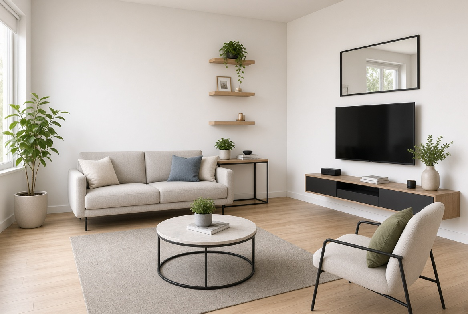
6pbqo How to arrange furniture in a small living room can feel like a puzzle at first. You may have a sofa, chairs, a coffee table, a television, and several other items, yet the room may still feel crowded.
However, a small living room does not have to feel uncomfortable.
With the right layout, you can create a room that feels open, useful, cozy, and attractive. More importantly, you do not always need to buy new furniture. Sometimes, moving the pieces you already own can make a huge difference.
In this guide, you will learn how to arrange furniture in a small living room step by step. We will look at furniture size, walking paths, focal points, rugs, tables, lighting, storage, television placement, windows, doors, corners, and more.
You will also find real-life examples, simple case studies, advantages and disadvantages, expert advice, a comparison chart, common mistakes, and 20 frequently asked questions.
Interior design experts often stress the importance of scale, purpose, and flow. Architectural Digest, for example, notes that scale and proportion matter greatly in small rooms, while every furniture piece should have a useful purpose.
So, let’s make your small living room work harder without making it feel packed.
Start by Measuring the Entire Room
Before learning how to arrange furniture in a small living room, measure the space.
This simple step can prevent many expensive mistakes.
Measure the room’s:
- Length
- Width
- Door openings
- Window openings
- Fireplace
- Built-in shelves
- Radiators
- Heating vents
- Wall outlets
- Television connections
- Walking paths
Also, measure every large piece of furniture.
Write down the dimensions of your:
- Sofa
- Chairs
- Coffee table
- Side tables
- TV stand
- Bookcase
- Cabinet
- Ottoman
Then draw a basic floor plan on paper.
You do not need special design software. A pencil, ruler, and piece of paper can work perfectly.
Better yet, mark furniture sizes on the floor with painter’s tape. This lets you see how much floor space each piece will occupy before you move anything heavy.
How to Arrange Furniture in a Small Living Room Around Real Life
A beautiful room is not useful if nobody can use it comfortably.
Therefore, think about how your family actually uses the room.
Do you:
- Watch television?
- Read books?
- Talk with family?
- Work from home?
- Play games?
- Host visitors?
- Eat snacks?
- Play with children?
- Relax with pets?
Your answers should guide the layout.
For example, a television-focused room needs seating that faces the screen. On the other hand, a conversation-focused room should place chairs and sofas closer together.
Houzz recommends starting with the room’s function before deciding where furniture goes.
That advice is especially helpful in a small room because every square foot needs a job.
Find the Room’s Main Focal Point
Every living room benefits from a visual focus.
The focal point might be:
- A fireplace
- A large window
- A television
- A beautiful painting
- A bookcase
- An attractive view
- An architectural feature
Once you identify it, point your main seating toward it.
For example, if the television is the main focus, your sofa should provide a comfortable view.
If a large window provides beautiful daylight, you may want the seating to face or slightly angle toward it.
However, do not automatically make the television the center of the room. If the room has a fireplace or a beautiful window, those features may deserve more attention.
Choose One Main Furniture Anchor
One common mistake in small rooms is trying to make every piece equally important.
Instead, choose one anchor.
Usually, the anchor is the sofa.
The sofa establishes the direction of the seating area. Then, you can add a chair, coffee table, ottoman, or side table around it.
This approach creates order.
It also makes the room easier to understand visually.
Architectural Digest’s small-room guidance similarly recommends starting with intentional furniture choices and paying close attention to scale and proportion.
How to Arrange Furniture in a Small Living Room With a Sofa
The sofa usually takes up more space than any other piece.
Therefore, start there.
Try placing the sofa:
- Along the longest wall
- Across from the television
- Near a window without blocking it
- Facing a fireplace
- Slightly away from the wall
- At an angle when the room allows it
Do not assume the sofa must always touch a wall.
Sometimes floating it slightly away from the wall creates better movement.
However, floating furniture only works when enough space remains for people to walk around it.
A recent design discussion from The Spruce also highlights floating furniture as a way to improve traffic flow, although it stresses that furniture scale remains important.
Keep Walking Paths Clear
Good traffic flow may be the most important part of a small living room.
People should be able to walk through the room without bumping into furniture.
Pay special attention to paths between:
- The door and sofa
- Sofa and coffee table
- Sofa and kitchen
- Sofa and hallway
- Seating and bathroom
- Seating and balcony
- Chairs and television area
Instead of placing furniture wherever it fits, create clear routes.
A room can contain several pieces of furniture and still feel open if the walking paths remain easy to use.
Create a Simple Traffic Map
Imagine invisible lines across the room.
Now ask:
Where does everyone walk?
For example, perhaps the main route runs from the entrance to the kitchen.
If your coffee table blocks that route, move it.
If a chair sticks into the path, turn it.
If the sofa creates a narrow passage, try another wall.
This is one of the easiest ways to improve a room without spending money.
How to Arrange Furniture in a Small Living Room With a Coffee Table
A coffee table should be useful without becoming an obstacle.
Choose a table that leaves enough room for people to sit comfortably and walk around.
Round or oval tables can work especially well when the room has many corners or narrow paths.
A square table can work well with a square seating arrangement.
A narrow rectangular table can work nicely in a long room.
Also, consider an ottoman.
An ottoman can serve as:
- Footrest
- Extra seat
- Coffee table
- Storage unit
- Flexible furniture
That makes it especially useful in a small home.
Use an Ottoman Instead of Multiple Small Tables
Too many small tables can make a room look busy.
Instead, consider one larger multifunctional piece.
For example, a storage ottoman can provide seating, foot support, and hidden storage.
This follows a useful small-space principle: furniture should ideally perform more than one job.
Better Homes & Gardens also recommends multipurpose furniture and hidden storage when people need to make the most of smaller spaces.
Choose Chairs That Do Not Overwhelm the Room
A large armchair can take up surprisingly much space.
Therefore, look for chairs with:
- Slim arms
- Smaller depth
- Open legs
- Light visual weight
- Comfortable but compact cushions
You do not necessarily need tiny furniture.
In fact, designers sometimes warn that filling a small room with too many tiny pieces can make the room look even smaller.
The goal is balance, not simply small size.
How to Arrange Furniture in a Small Living Room With Two Chairs
If you have two chairs, place them where they support conversation.
One option is to place both chairs across from the sofa.
Another option is to place one chair at each end of the seating area.
You can also angle the chairs slightly toward the sofa.
Avoid creating a layout where everyone faces a different direction.
Good furniture arrangement encourages people to talk.
Try a Sofa and One Chair Layout
You do not need four or five seating pieces.
A sofa plus one comfortable chair can create a complete living room.
Add a small table or ottoman, and you may already have everything you need.
This arrangement works particularly well for:
- Couples
- Small families
- Studio apartments
- One-bedroom apartments
- Narrow living rooms
It also leaves more open floor space.
Consider a Small Sectional
A sectional can work in a small room when its dimensions fit correctly.
Do not choose a sectional simply because it is labeled “small.”
Measure it carefully.
A sectional can provide several seats while using one connected piece of furniture.
Architectural Digest notes that a well-chosen sectional can maximize seating in a tiny room, while designers caution against assuming that the smallest possible furniture is always the best answer.
How to Arrange Furniture in a Small Living Room With a Sectional
Start by placing the sectional along two walls or near one main wall.
Then identify where people will enter and leave the room.
Keep the open side of the sectional from blocking the main walkway.
If possible, place the chaise portion in a corner.
That can turn an awkward corner into useful seating.
However, always check door swings and walking routes before finalizing the position.
Use Corners Instead of Ignoring Them
Corners often become wasted space.
Instead, turn them into useful areas.
You can place:
- A reading chair
- Tall lamp
- Small plant
- Corner shelf
- Small cabinet
- Floor basket
- Compact desk
However, avoid filling every corner.
A few open areas can make the room feel calmer.
How to Arrange Furniture in a Small Living Room Near Windows
Windows bring light into a small room.
Therefore, avoid blocking them with tall furniture when possible.
Keep curtains simple.
Use furniture that allows daylight to travel through the room.
Furniture with visible legs can also create a more open visual effect because you can see more floor beneath it. Architectural Digest recently highlighted this exact benefit, explaining that elevated furniture can keep the floor sight line open.
Let Natural Light Do Some of the Work
Natural light can make a small room feel brighter and more open.
Therefore:
- Keep windows clear.
- Avoid tall cabinets directly in front of windows.
- Use light curtains.
- Keep bulky furniture away from the brightest areas when possible.
- Use mirrors carefully to reflect light.
You do not need to make the entire room white.
Instead, use a simple color scheme with a few strong accents.
Place the Television Without Dominating the Room
Television placement often creates layout problems.
First, decide where the screen should go.
Then arrange seating around it.
If possible, wall-mounting the television can eliminate the need for a large TV cabinet.
However, a low console may still be useful for storage.
Houzz recommends orienting furniture toward the main focal point and gives television viewing distance as one consideration when planning the layout.
How to Arrange Furniture in a Small Living Room Around a TV
Avoid placing the television where windows create strong glare.
Also, avoid making people turn their necks to watch it.
Place the sofa and chairs so that most seats have a comfortable viewing angle.
If the room serves several purposes, consider a movable chair.
That chair can face the television during movie night and turn toward the sofa during conversations.
Use a Rug to Connect the Furniture
A rug can make separate pieces look like one seating area.
Place at least part of the main seating furniture on the rug when possible.
A rug that is too small may make the furniture look disconnected.
However, a rug that is too large can overwhelm a tiny room.
Choose a size that creates a clear seating zone without blocking important paths.
Designers interviewed by The Spruce also emphasize that rug size affects how cohesive a living room feels.
How to Arrange Furniture in a Small Living Room With a Rug
Start with the sofa.
Then place the rug so it connects the sofa with the chairs and table.
If the room is very small, even having the front legs of the seating on the rug can visually connect the group.
Keep the rug clear of doors that need to open.
Also, make sure the rug does not create a trip hazard.
Pick Furniture With Visible Legs
Furniture with exposed legs can make a room look lighter.
Why?
Because your eyes can see more floor.
That creates a sense of openness.
Heavy furniture that sits completely flat on the floor can create a stronger visual block.
Therefore, consider:
- Raised sofas
- Legged chairs
- Open-base tables
- Raised cabinets
This does not mean every piece needs legs.
Instead, mix solid and open pieces for balance.
Use Vertical Space for Storage
Small rooms have limited floor space.
So look upward.
Tall shelves can store books and decorative items without taking up much floor area.
Wall-mounted shelves can also work well.
Other ideas include:
- Tall cabinets
- Floating shelves
- Wall-mounted lights
- High bookcases
- Narrow storage towers
Just avoid filling every wall.
Too many objects can create visual clutter.
How to Arrange Furniture in a Small Living Room With Storage
Storage should support the room instead of taking it over.
Choose furniture that hides everyday clutter.
For example:
- Storage ottoman
- Sofa with drawers
- Small cabinet
- Shelving unit
- Baskets
- TV console
Architectural Digest recommends furniture that earns its place by providing useful functions such as storage.
This principle can save valuable floor space.
Keep Side Tables Small and Useful
You may not need a side table beside every seat.
Instead, place one where people actually need it.
A small table can hold:
- Lamp
- Phone
- Book
- Drink
- Remote control
If the room feels crowded, remove an unnecessary table.
You may discover that the room immediately feels larger.
How to Arrange Furniture in a Small Living Room Without a Coffee Table
A coffee table is useful, but it is not required.
You can replace it with:
- Ottoman
- C-shaped table
- Small nesting tables
- Side table
- Storage stool
This can create more walking space.
It also makes the layout easier to change.
For example, you can move a small table when guests arrive.
Use Nesting Tables for Flexible Space
Nesting tables provide two or three surfaces while occupying a small footprint.
Use the larger table when you need it.
Then slide the smaller tables underneath when you need more open space.
This is especially useful for people who often host guests.
How to Arrange Furniture in a Small Living Room With a Fireplace
If you have a fireplace, consider making it the focal point.
Place the sofa opposite or slightly angled toward it.
Then add one or two chairs.
Avoid pushing every piece directly against the walls.
Instead, create a small conversation group around the fireplace.
If the television is also above the fireplace, arrange seating so that both functions work together.
Do Not Push Every Piece Against the Wall
Many people believe that pushing furniture against walls creates more space.
Sometimes it does.
However, it can also make a room feel stiff.
A small amount of breathing room can make the arrangement feel more intentional.
Architectural Digest similarly advises allowing furniture to breathe instead of pressing every piece tightly together.
Still, do not float furniture simply for appearance.
Traffic flow always comes first.
Use Symmetry When the Room Feels Messy
Symmetry can make a small room feel organized.
For example:
- Sofa in the center
- Chair on each side
- Matching lamps
- Balanced wall art
However, perfect symmetry is not required.
A sofa and two different chairs can look great when their visual weight feels balanced.
Break Symmetry When You Need More Floor Space
Sometimes a symmetrical layout uses too much furniture.
In that case, remove one chair.
Replace it with a small stool.
Or use a floor lamp instead of a table lamp.
The goal is not to follow a design rule perfectly.
The goal is to make the room comfortable.
Create a Conversation Zone
If you want a room that encourages talking, place seating closer together.
The sofa and chairs should face toward one another rather than all facing the television.
A small coffee table can sit between them.
This setup works well for:
- Family conversations
- Reading
- Coffee
- Board games
- Visiting friends
Houzz also recommends considering conversation when determining seating placement.
Create a Reading Corner
A tiny reading corner can add personality without using much space.
Choose:
- One comfortable chair
- Small lamp
- Narrow table
- Small bookshelf
Place it near natural light if possible.
However, make sure the chair does not block a main walkway.
How to Arrange Furniture in a Small Living Room for Families
Families need flexible furniture.
A room may need to support television time, homework, play, and visitors.
Therefore, choose pieces that can move easily.
For example, lightweight chairs can move closer to the sofa when guests arrive.
An ottoman can become extra seating.
A storage basket can quickly hide toys.
The best layout is often the one that adapts to changing needs.
Make a Small Living Room Kid-Friendly
If children use the room, leave open floor space.
Avoid sharp furniture corners when possible.
Keep breakable decorations away from busy areas.
Choose washable fabrics when practical.
Also, secure tall furniture properly.
Safety should always come before appearance.
Use Lighting to Make the Room Feel Bigger
Do not rely on one ceiling light.
Use several light sources.
For example:
- Floor lamp
- Table lamp
- Wall light
- Ceiling light
- Window light
Different heights create visual layers.
Architectural Digest has also highlighted the value of multiple lighting sources in making small spaces feel more interesting and visually open.
How to Arrange Furniture in a Small Living Room for Better Lighting
Place a reading chair near a lamp.
Place a sofa where it receives comfortable daylight.
Avoid putting tall furniture in front of your main window.
Also, use mirrors thoughtfully.
A mirror opposite or near a light source can help reflect brightness around the room.
Keep Decorations Under Control
Small rooms can become crowded quickly.
Therefore, decorate with purpose.
Instead of placing ten objects on a coffee table, try three.
Instead of filling every shelf, leave some empty space.
Instead of covering every wall, choose a few meaningful pieces.
The Spruce’s recent advice on small-space decorating also emphasizes reducing clutter and avoiding too many decorative objects.
How to Arrange Furniture in a Small Living Room on a Budget
You do not need a new sofa to improve the room.
Try these free or low-cost changes first:
- Remove unused furniture.
- Move the sofa.
- Turn a chair.
- Remove one side table.
- Move the television.
- Change the rug position.
- Add a lamp.
- Move plants.
- Declutter shelves.
- Rearrange artwork.
Architectural Digest has specifically noted that rearranging existing furniture can make a room feel fresh without buying new pieces.
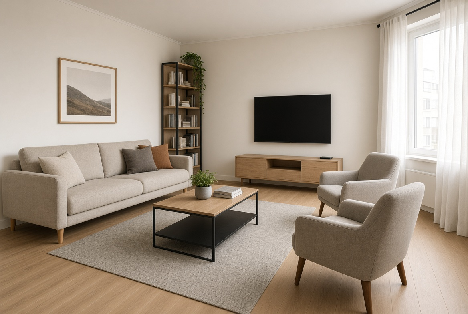
Real-Life Example: A 10-by-12-Foot Living Room
Imagine a 10-by-12-foot room.
It contains:
- One three-seat sofa
- One chair
- One coffee table
- One TV stand
- Two side tables
The owner originally places everything around the walls.
The result feels crowded.
Instead, they remove one side table, move the sofa slightly forward, angle the chair toward it, and use a smaller coffee table.
Now the center feels more open.
The room still contains the same main furniture, but the layout works better.
That is the power of arrangement.
Case Study: A Narrow Apartment Living Room
Consider a narrow apartment measuring about 8 by 14 feet.
The owner wants both television seating and a reading area.
Instead of adding several chairs, the owner uses:
- One compact sofa
- One lightweight reading chair
- One small round table
- One narrow media console
The sofa faces the television.
The chair sits near the window.
The round table serves both seating areas.
As a result, the room supports two activities without creating two separate furniture piles.
Case Study: A Small Family Living Room
A family has a compact living room with a sofa, two chairs, television, toy storage, and coffee table.
The first arrangement blocks the main walkway.
The family removes one chair and replaces the large coffee table with a storage ottoman.
The sofa remains the main anchor.
The ottoman provides seating, storage, and a place for feet.
The family gains more walking space without losing the room’s main functions.
Advantages and Disadvantages of Different Layouts
| Layout | Best For | Advantages | Disadvantages |
| Sofa against wall | Very small rooms | Saves floor space | Can feel stiff |
| Floating sofa | Open layouts | Better flow | Needs more room |
| Sofa + chair | Couples | Simple and flexible | Less seating |
| Sofa + two chairs | Families | More seating | Uses more floor space |
| Small sectional | Lounging | Lots of seating | Less flexible |
| Two chairs + ottoman | Conversation | Flexible | Less back support |
| Sofa + round table | Narrow rooms | Easy movement | Less table surface |
| Sofa + storage ottoman | Small families | Multi-use | Can look bulky |
| Corner sectional | Square rooms | Uses corners well | Difficult to move |
| No coffee table | Tight spaces | Maximum floor space | Less convenient |
Expert Advice for Small Living Room Furniture
Design experts generally agree on several useful ideas.
First, scale matters.
Second, function comes before decoration.
Third, too many small pieces can create clutter.
Fourth, multipurpose furniture can save space.
Fifth, good traffic flow matters more than filling empty areas.
Architectural Digest reports that designers often recommend choosing pieces carefully rather than automatically buying the smallest possible furniture.
Therefore, do not assume that a tiny sofa will always make your room look larger.
Sometimes one properly sized sofa looks better than three tiny chairs.
The Final Test: Live With the Layout
After arranging everything, do not judge the room immediately.
Live with it for a day.
Walk through it.
Sit on every chair.
Watch television.
Open the doors.
Walk to the kitchen.
Clean the room.
Ask yourself:
- Can everyone move easily?
- Can people talk comfortably?
- Can I reach the table?
- Can I open doors?
- Does the room receive enough light?
- Does the furniture feel balanced?
- Is anything unnecessary?
If something feels wrong, move it.
You do not need to find the perfect arrangement on the first attempt.
In fact, trying several layouts is often the best way to discover what works for your home.
How to Arrange Furniture in a Small Living Room: Quick Layout Formulas
Here are several simple formulas you can test.
Formula 1: Sofa + Chair + Round Table
Best for a narrow room.
Place the sofa along the long wall. Put one chair opposite or at an angle. Use a round table in the center.
Formula 2: Sofa + Two Small Chairs
Best for families.
Place the sofa opposite the focal point. Put two compact chairs near the sofa to form a conversation area.
Formula 3: Sectional + Ottoman
Best for movie lovers.
Place the sectional in a corner. Use a small ottoman instead of a large coffee table.
Formula 4: Sofa + No Coffee Table
Best for extremely small rooms.
Keep the center open. Use small side tables instead.
Formula 5: Sofa + Reading Corner
Best for multipurpose rooms.
Create the main seating area with the sofa, then place one chair and lamp near a window.
Common Furniture Arrangement Mistakes to Avoid
Buying Furniture Before Measuring
This is one of the most expensive mistakes.
Measure first.
Then buy.
Using Too Many Small Pieces
More furniture does not automatically mean more comfort.
Often, fewer well-sized pieces work better.
Blocking Doorways
Never sacrifice a clear doorway for decoration.
Blocking Windows
Natural light is valuable.
Keep it open whenever possible.
Using a Huge Coffee Table
A large table can destroy walking space.
Choosing a Tiny Rug
A rug that is too small can make the seating look disconnected.
Ignoring Vertical Storage
Walls can provide useful storage without taking floor space.
Filling Every Corner
Empty space is useful.
It gives the eye a place to rest.
Forgetting Real Life
A room should look good, but it should also work for the people who live there.
A Simple Weekend Furniture Rearrangement Plan
If you want to improve your living room this weekend, follow this plan.
Saturday Morning: Measure
Write down room dimensions and furniture dimensions.
Saturday Afternoon: Remove Clutter
Take out anything you do not use.
Saturday Evening: Test Layout One
Try your sofa against the best wall.
Sunday Morning: Test Layout Two
Move the sofa and test another arrangement.
Sunday Afternoon: Add the Rug
Place the rug to connect the seating.
Sunday Evening: Add Lighting
Use lamps to brighten darker areas.
Then live with the layout for several days.
FAQs About How to Arrange Furniture in a Small Living Room
- How to arrange furniture in a small living room without making it feel crowded?
Start with the sofa, keep clear walking paths, remove unnecessary furniture, and use pieces that perform more than one job.
- Should a sofa touch the wall in a small living room?
Not always. A sofa can sit slightly away from the wall when enough space exists for people to walk around it. However, a wall placement may work better in an extremely small room.
- What furniture should go first?
Start with the largest and most important piece, usually the sofa. Then add chairs, tables, storage, and accessories.
- How much furniture should a small living room have?
There is no fixed number. Use enough furniture for the room’s main activities while keeping clear walking routes.
- Is a sectional good for a small living room?
Yes. A properly sized sectional can provide plenty of seating. However, measure it carefully before buying.
- Should a small living room have a coffee table?
Not necessarily. An ottoman, nesting table, or small side table can work instead.
- What shape coffee table works best in a small room?
Round and oval tables often work well because their curved edges can make movement easier.
- How can I make my small living room look bigger?
Reduce clutter, use suitable furniture scale, keep walking paths open, allow natural light in, and avoid overcrowding the floor.
- Should furniture face the television?
If television viewing is one of the room’s main activities, yes. However, the television does not have to be the room’s only focal point.
- Can I float furniture in a small room?
Yes, but only when the layout leaves enough room for comfortable movement. Floating furniture should improve the room rather than block traffic.
- How do I arrange furniture in a long, narrow living room?
Place the main sofa along the longer wall or use it to define the main seating zone. Then use compact chairs or tables to avoid creating a cramped center.
- How do I arrange furniture around a window?
Keep the window as open as practical. Avoid tall furniture that blocks light and views.
- How do I arrange furniture around a fireplace?
Make the fireplace a focal point and position the main seating toward it. Then add a chair or small table without blocking the walking path.
- Can a large sofa work in a small living room?
Yes. A properly scaled large sofa can sometimes look better than several small furniture pieces. The key is leaving enough room for movement.
- Should all furniture match?
No. Furniture can have different styles as long as the pieces share some colors, materials, shapes, or visual weight.
- What is the biggest small living room mistake?
One major mistake is adding too much furniture. Another is ignoring traffic flow.
- How can I add storage without losing floor space?
Use vertical shelves, wall-mounted storage, storage ottomans, and furniture with hidden compartments.
- Should I use a rug in a small living room?
Usually, yes. A correctly sized rug can visually connect the seating area and make the room feel more organized.
- How often should I rearrange my furniture?
There is no required schedule. Rearrange it whenever the room stops working for your daily needs.
- What is the most important rule for small living room furniture?
Choose furniture based on your real needs, measure before buying, and protect clear walking paths.
Final Thoughts
Learning how to arrange furniture in a small living room does not require expensive furniture or professional design software.
Instead, it requires planning.
Start by measuring the room. Then identify the focal point. Next, place the largest furniture piece. After that, build the seating area around it.
Keep walking paths open.
Use furniture that can perform more than one job.
Let natural light enter the room.
Use rugs and lighting to define the space.
Most importantly, do not fill every empty area simply because you have space available.
A small living room can feel comfortable, stylish, and practical when every piece has a reason to be there.
The best layout is not necessarily the one that looks perfect in a photograph. It is the one that makes your everyday life easier.
So, test different positions, move what does not work, and give yourself time to live with each layout.
With a little patience, you can turn even a very small living room into a welcoming place for relaxing, talking, reading, watching movies, and spending time with the people you love.
Helpful External Resources
For additional design guidance, these resources are useful:
- Architectural Digest — Small Living Room Ideas — Helpful examples of small-room layouts, furniture scale, storage, rugs, and visual tricks.
- Houzz — How to Get Your Furniture Arrangement Right — Covers room function, focal points, furniture placement, symmetry, and conversation areas.
- Architectural Digest — Small Space Decorating Tips — Useful advice about multipurpose furniture, storage, and allowing furniture to breathe.
- Architectural Digest — Floating Furniture in Small Rooms — Explains when moving furniture away from walls can improve a small space.
- Better Homes & Gardens — Downsizing Without Losing Storage or Style — Offers practical ideas for multipurpose furniture and hidden storage.